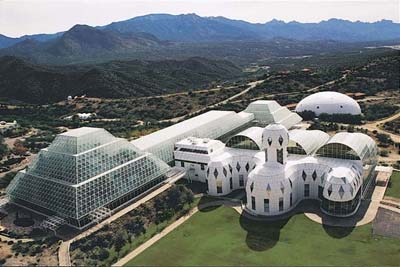
 I wanted to start this reflection by making a comment on the picture to the left. There really was a Biosphere 2? I thought that was only a movie by Paulie Shore! Well I'll be darned.
So this is a pretty good article if you love reading about statistics all day. The overall tone is pretty optimistic and a rare case that I don't feel like crying myself to sleep after reading. I just think that Lovins et al draw too much their percentage change of this and that. They are throwing around numbers way too much, and I'm sure that if most of these were checked out, they would not add up.
That said, I admire them for going through the whole process of calculating these amounts, because there is no doubt in anyone's mind that reducing paper consumption will save trees, and blah blah blah. Actually, when I was helping my uncle lay the pipes in his chalet, he made sure we used as many straight lines of copper pipes as possible because he said it caused less resistance. So I was pretty happy to know this already once I read it in the text.
The ideas of adopting innovative technologies are novel ones. We must really stop thinking about what is easy and start thinking about what is right for the environment. I loved the statistic that said that only 1% of all product inputs come out as actual products. So much of what we make is wasted every single day.

One last comment I want to make is about this movement to replicate nature: biomimicry. It makes so much sense because you always hear of animals and plants doing things so unimaginable that you wonder how it's done. Everyone has heard that spider webs are some of the strongest material on the earth. And this summer, I saw a spider eat its own web probably recycling it to make another at a later time. I just wanted to say that nature was so cool and that we should do our best to keep it healthy


