Wednesday, November 12, 2008

Road Map to Capitalism

If nature were a business, it would gross $33 Trillion dollars in profits every year.

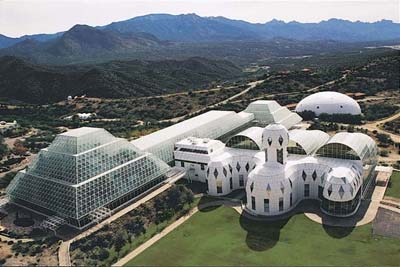
I wanted to start this reflection by making a comment on the picture to the left. There really was a Biosphere 2? I thought that was only a movie by Paulie Shore! Well I'll be darned.

So this is a pretty good article if you love reading about statistics all day. The overall tone is pretty optimistic and a rare case that I don't feel like crying myself to sleep after reading. I just think that Lovins et al draw too much their percentage change of this and that. They are throwing around numbers way too much, and I'm sure that if most of these were checked out, they would not add up.

That said, I admire them for going through the whole process of calculating these amounts, because there is no doubt in anyone's mind that reducing paper consumption will save trees, and blah blah blah. Actually, when I was helping my uncle lay the pipes in his chalet, he made sure we used as many straight lines of copper pipes as possible because he said it caused less resistance. So I was pretty happy to know this already once I read it in the text.

The ideas of adopting innovative technologies are novel ones. We must really stop thinking about what is easy and start thinking about what is right for the environment. I loved the statistic that said that only 1% of all product inputs come out as actual products. So much of what we make is wasted every single day.

One last comment I want to make is about this movement to replicate nature: biomimicry. It makes so much sense because you always hear of animals and plants doing things so unimaginable that you wonder how it's done. Everyone has heard that spider webs are some of the strongest material on the earth. And this summer, I saw a spider eat its own web probably recycling it to make another at a later time. I just wanted to say that nature was so cool and that we should do our best to keep it healthy

Wednesday, November 5, 2008

Global Economy and the Third World

This is one of the best articles so far this year albeit having a negative tone. I like that Khor made us realize that, yes most third world countries were not well off before colonization and globalization, but at least they were self sufficient. Through indigenous techniques, they were able to keep themselves and most of the community fed. With globalization, companies brought in harsh working conditions, dangerous chemicals which come into contact with those people, and strip their land of resources.

Khor is the president of the Third World Network, in which he is the leading voice behind the opposition of the current pattern of globalization. I TOTALLY agree with that!!! There is a definite need to globalize and modernize the planet, but the way we are going about it for the most part is totally wrong. Khor seems to have the right idea here.

Back to my previous point. Khor points out that so much harm has been inflicted upon third world countries by cash hungry corporations such as the Bhopal disaster in India where so many died. And these companies pinned communities against each other to compete in agricultural production. The ones that didn't use expensive fertilizers had to bite the dust. All the companies care about is to tear the land clean of resources.

A perfect example is fishing boats having to go out further and further into the sea to catch fish because of so much overfishing. People in the third world won't have access to fish supply because they don't have boats that can go out to sea.

There are so many examples of misuse of resources or mistreatment of people, and Khor outlines these methods. What he is calling for is a new methodology. We cannot repeat the same things we did in the past and expect different results. That will never happen.

He has a nice call to action in the end. Not only does he want us to stop tearing at the earth for luxury resources, he also says to stop undertaking massive projects like the Three Gorges Dam or nuclear power plants

Wednesday, October 29, 2008

Stiglitz: Globalism's Discontent.

Here is another perfect Social Context paper: the negative side of a potentially good thing. We have been seeing this side for a long time now. Are we being manipulated into becoming anti capitalist, anti modernization, anti greed, anti globalization people? Well whatever the answer is, I feel like that a little bit. I understand why globalization might have its negative sides, but talk about its good aspects please. ..................................................................................... That's Stiglitz right there --->

If China never globalized, how would the Olympics ever had made their way to Beijing. How much infrastructure would be lacking around that area? I just feel like globalization may help few in the beginning, but slowly everyone will be benefited in the long run.

Look what non-globalization has done in countries in Eastern Europe or Africa. They need to embrace capitalism and globalize their countries. Now that industrialization has happened, colonization is long gone, globalization is the next step the world as a whole needs to take. Globalization brings the world to our backyard. It makes us all secular. And God knows that the Americans need to be secular, they don't know that there are more countries in the world than just themselves.

The process may be long, but in the end social justice will be found.

Globalization may have its bad sides, but that's the only way we are going to be able to band together and fight the other problems we have on this earth: poverty and global warming.

Entry on Dialogue Practise

Dialogue in our social context class is not always exactly dialogue. Sometimes it goes off on rants, arguments, side subjects, and rarely stays on topic to answer the question at hand. But who are we to blame, this is a relatively new experience to us students, we never really know what to do and where to take the subject. Everyone as they ready the paper or watched the movie had one or two important things that they wanted to discuss to the whole class to show that they understood something. Well when you have a class of 50, where about only 20% of the class actually does speak, that's about 10 people with 20 ideas that they want to relay to the class. With this many ideas, and not that much time, the true topic at hand never seems to get discussed and "dialogued" properly. I don't want to blame anyone on this because we still are new at dialoguing like I previously mentioned. It is great to get our ideas out, but we need to focus in more on what we are being asked to do. I am a prime example of what I just described. After watching, reading or observing, I always set a couple of things in my head to say to the class. I want to get my idea out. Well, if I'm not the first one speaking, then no matter what the person says before me, I'll nod or disagree, and then go off onto my tangent and the way that I wanted my conservation to go. In this regard, I did not accomplish the task of dialogue whatsoever. I may have said something witty, or smart or something that had nothing to do with what we were doing, which deterred us from our goal.

With so many people in the class, even if our dialogue takes us somewhere, with a few good exchanges, it is very hard to keep everyone on track. And what about all of the people who never have spoken in class or have spoken once or twice; Those people could do very well by saying what they actually felt or observed. They could break out of their shell and give their insights but with a big class like that, the task of speaking in front of everyone may seem a little daunting.

The purpose of this exercise is to not only hear what others have to say, but understand and build on what they have said. We need to open other people's eyes to other perspectives and also allow them to look at themselves in a third person view to better understand their selves. I don't know if I'm making too much sense here, but these exercises open up a lot of subjects, and evoke feelings into people. Now what these feelings do I'm not so familiar with but it could have positive effects on the mind and how we think. This is the role of dialogue I believe.

In class, we have had some semblance of dialogue, but it should go a little bit further than that. We need to start involving more people and get them out of their comfort zone. Get someone that may be unprepared to speak to voice his or her opinion. Usually it's the same people in class talking and we do not want that. We want people who don't usually talk to hear what they have to say and the insights that they have to give on the current topic. Let's toss around a ball randomly and whoever catches says a few comments on the task at hand. Or even better, everyone should go one by one and give just a few thoughts maybe 15-30 seconds long. Whatever we have to do to get people involved is what we have to do. We need a more serious moderator who will do a better job to keep us on track and initiate dialogue when things are not going well. We need to be comfortable with silence and allow a minute of silence between segments to make sure that people are aware and that they can think without others talking in their ear.

I think we need to eliminate arguments whenever they arise and give 30 second time limits to anyone on any subject they are talking about. Watch less movies and do more games is something that I would really enjoy doing. Let's do icebreaker games even though we may know each other. Let's get some communication going, let's see some smiles in people's faces. Isn't this what this class is about. Learning, but without all the stress associated with endless assignments, midterms and finals. This class should be fun and treated as such. It should not however, be goof-off time and time to stray from topics. We have to stay organized.

I have a couple of questions. Why have we not had that many guest speakers come in for 30 minutes or so. I'm sure that many people in the area around Montreal will be more than happy to come and talk to us about their initiatives or what they do. I would be interested to get other people's perspective and also for us to discuss that further.


Intuitive understanding of purpose behind exercise
Feelings on actual experience in class
Experience regarding a shift in perspective (or not) as a result of these practices
Your recommendations of how to improve
Your questions
Wednesday, October 22, 2008

Social Responsible Investing

Just when you thought being eco-friendly meant not only changing your light bulbs and composting trash, but also living sustainable lives and the move towards corporate social responsibility, another facet of environmentalism comes out. This is how I felt when I found out about socially responsible investing. I didn't think about it before but for us to embrace the environment and ensure its safety for the future, every part of business has to be sustainable. I don't mean to make a plug about your business, Ms. Gladu, but your business which is very capital intensive might not have gone through without some responsible investing. Quite frankly, responsible investing is what starts the dream altogether, and it also keeps it going for the future of a greener planet.

I have a quick comment to make about part of the article. The part where she gives us a glance at SRI around the world. To be honest, I don't know how much that actually helps. I mean we're 2008 now and I haven't heard of these investments and how they have made everything better.

I agreed with her comment about educating students about responsible investing. I just have one comment on that, teach CURRENT CEO's too, they need to know this stuff too. I mean we are the next generation, but they will be working for as much as 30 more years too.

Last comment I promise I will make it short!! Let's get Brenda Plant to come in our classroom sometime soon and get her to talk to us!! Her business is really close to school!!

Wednesday, October 15, 2008

Voluntary Simplicity


Singleness of purpose, sincerity and honesty within, avoidance of external clutter, of many possessions irrelevant to the chief purpose of life.

That is one of the most concise definitions I have seen in a long time. It really set the mood for this article. It is kind of a shame that I will miss class today because I would have liked to hear what the other classmates thought about this paper.

Oh, and by the way, NOOOOO! While reading this article about voluntary simplicity, the first thoughts that came to my head were of Henry David Thoreau, whose want for simplicity pushed him to live life in the woods as it told in his book Walden Pond. I guess the author had him in mind as well while writing this piece.

Another great quote I read, "Poverty is involuntary and debilitating while simplicity is voluntary and enabling." I like how he says things. But he's right, poverty is so nasty and sad; as residents of Montreal we see that on a daily basis.

Other observations in this article: the gap between rich and poor, and how that gap is widening so significantly every single day.

How lucky was I to be brought into a great home and upbringing. I mean I'm not a big gambling buff but if theres 6 billion people on earth and 1.2 billion live in absolute poverty, I dodge a bullet when I was born. Others aren't so lucky. The picture below represents the slums in a town, while the rich flourishing skyscrapers of wealth and capitalism provide a good backdrop for the people living in the shanties.

Monday, October 6, 2008

Ethics and Decison Making

Been There, Read That!


There we go with another short paper on ethics and business morals once again. How many different papers do I have to read about this!?! Well actually I took a ethics course for philosophy so maybe that's why I'm feeling the slight overkill.

I did enjoy a novel example of moral ambiguity in business, in how a firm makes decisions. The Intel case provides examples that Intel only replaced defective chips if the user was savvy enough to catch the defect. But the average person who uses Intel chips in in their computers have very little knowledge of how they work so they wouldn't get the newer chips. That is an example of an ethical dilemma of immoral acts or inaction.

To follow a new trend in our readings, we saw yet another example of firms doing good things in ethics. Hewlett-Packard has standardized rules in which their employees and upper management follow. The ethics are ingrained in their corporate culture making ethical decision making easier for employees.

To summarize, I just want to point out something that this article made me think about. A lot of times your decision to either perform or not perform an immoral and/or unethical act very much depends on whether you think you will get caught or not. That always gets me.